Anime Information
Voice Cast
Dante
Toshiyuki MorikawaPatty Lowell
Misato FukuenLady
Fumiko OrikasaTrish
Atsuko TanakaJ.D. Morrison
Akio OtsukaSid
Nachi NozawaSeasons & Episodes
Season 1
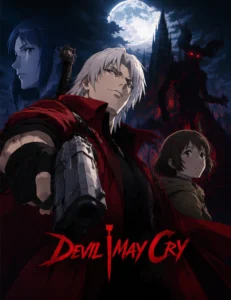
2007Devil May Cry Season 1 follows Dante, a powerful demon hunter who runs the Devil May Cry business while taking on dangerous supernatural jobs. Although Dante often struggles with money and appears careless, his abilities make him one of the most capable fighters against demonic threats.
| # | Episode | Air Date | Rating | Duration |
|---|---|---|---|---|
| 1 | 14/06/2007 | ★ 8.0 | 24 minutes | |
| 2 | 21/06/2007 | ★ 7.5 | 24 minutes | |
| 3 | 28/06/2007 | ★ 8.0 | 24 minutes | |
| 4 | May 7, 2007 | ★ 8.0 | 24 minutes | |
| 5 | Dec 7, 2007 | ★ 7.5 | 24 minutes | |
| 6 | 19/07/2007 | ★ 8.5 | 24 minutes | |
| 7 | 26/07/2007 | ★ 7.5 | 24 minutes | |
| 8 | Feb 8, 2007 | ★ 8.5 | 24 minutes | |
| 9 | Sep 8, 2007 | ★ 8.0 | 24 minutes | |
| 10 | 23/08/2007 | ★ 8.0 | 24 minutes | |
| 11 | 30/08/2007 | ★ 8.5 | 24 minutes | |
| 12 | Jun 9, 2007 | ★ 8.5 | 24 minutes |
Anime Review
If you’re a Devil May Cry fan, the 2007 anime is an interesting experience.
Some fans went into it hoping for a direct adaptation of the games. Instead, the anime takes a different route. Rather than retelling the events of a game, it tells an original story set after the first Devil May Cry game, giving us a chance to spend more time with Dante and explore a side of his character that the games don’t always focus on.
As a longtime fan of Devil May Cry, I genuinely enjoyed the series. Is it perfect? Absolutely not. There are writing issues, some strange plot decisions, and noticeable animation mistakes. But there is something charming about this anime. It’s not really about giving Dante one giant adventure. It’s about showing us Dante’s life between the big adventures. And surprisingly, that can be just as interesting.
What Is Devil May Cry (2007) About?
The Devil May Cry anime follows Dante, the legendary demon hunter and owner of the Devil May Cry agency.
Dante is the son of Sparda, one of the most powerful demons in existence, and Eva, a human woman. Despite having an incredibly powerful heritage, Dante’s childhood was filled with tragedy. He lost his family, grew up largely on his own, and eventually became a demon hunter. By the time the anime begins, Dante is already an experienced fighter. He has fought demons, survived countless battles, and established his own business. But there is something different about this version of Dante.
He seems depressed.
He’s still energetic when he needs to be. He’s still sarcastic. He’s still confident in battle. But underneath all of that, there’s a man who seems exhausted by his own life. And, perhaps most importantly, he’s broke.
A Different Side of Dante
One of the things I appreciated most about the anime is that it doesn’t constantly try to make Dante look cool. Yes, we get the guns. Yes, we get the sword. Yes, Dante destroys demons with style. But we also see him sitting around worrying about money. He can’t afford a pizza. His business isn’t exactly booming. Clients don’t always pay what they’re supposed to. And despite being the son of Sparda, Dante’s everyday life is surprisingly miserable. It’s actually a great contrast. Here’s a man who can take down incredibly powerful demons, yet he’s struggling to pay his bills. But his financial problems aren’t the only thing weighing on him. Dante carries a lot of emotional baggage.
His family was taken from him. His earlier friend was killed by a clone of Vergil created by Mundus, and he has spent much of his life dealing with the consequences of being Sparda’s son. He has people around him, including Lady, Trish and Enzo, but Dante still feels isolated. At times, he seems to be in a state of self-loathing. The anime doesn’t always explain exactly what is going on inside his head, but that’s part of what makes this version of Dante interesting.
The Anime Doesn’t Adapt the Game
This is probably the biggest thing potential viewers should understand. The 2007 anime doesn’t simply adapt the first Devil May Cry game. The story takes place after the first game and creates its own adventures. Some fans wanted the anime to adapt the games more directly, and I completely understand that criticism. The Devil May Cry games already have fantastic stories and characters, so an anime adaptation could have explored those stories in much greater detail.
Instead, the anime chooses to create its own path. And I actually think that’s both its biggest weakness and one of its biggest strengths. It’s a weakness because some stories feel disconnected. But it’s also a strength because we’re allowed to see Dante in situations that don’t have to recreate something we’ve already experienced in the games.
Each Episode Tells a Different Story
The anime has an episodic structure, with many episodes functioning almost like individual short stories. Dante takes a job. He meets someone. A supernatural problem appears. And eventually, Dante has to deal with it.
But underneath the demon hunting, many of these episodes are actually about human problems.
- Love.
- Greed.
- Revenge.
- Fame.
- Compassion.
- Jealousy.
- Regret.
- Ambition.
The demons are often the obvious threat, but the anime repeatedly asks a more interesting question:
Are demons really the worst thing about humanity?
Sometimes the real villain isn’t a demon at all. Sometimes it’s a human being.
Patty: The Real Heart of the Anime
The first episode introduces Patty, a young girl whom Dante is hired to escort. At first, Dante clearly doesn’t want to deal with her. She’s loud. She’s energetic. She’s constantly getting involved in his business. And Dante would much rather be doing almost anything else. But the relationship gradually changes.
What begins as an escort mission turns into one of the most important relationships in the series. Dante becomes attached to Patty. He starts protecting her not simply because he’s being paid, but because he genuinely cares about her. Their relationship slowly develops into something that feels like an older brother and younger sister relationship. And this is where the anime succeeds emotionally. Patty brings out a softer side of Dante.
The Truth About Patty
Patty’s story also becomes more complicated as the anime progresses. At first, she’s presented as a seemingly innocent young girl who needs Dante’s protection. But eventually, we learn that there is much more to her identity and her past. Her story becomes connected to Abigail, a powerful demon from the past, and the people who are interested in that power.
This revelation changes the way we look at Patty and explains why so many people are interested in her. However, I think this is also where the writing becomes a little shaky. The actual mythology surrounding Patty can feel unnecessarily complicated, and some of the explanations don’t land as well as they should.
The emotional part of Patty’s storyline is much stronger than the plot mechanics. Because the important thing isn’t really whether every detail surrounding her makes perfect sense. It’s Dante. He could have treated Patty like another job. Instead, he becomes emotionally invested in her.
For a character who spends so much of the anime acting like he doesn’t care about anything, that’s significant. Patty becomes someone Dante genuinely wants to protect. And that relationship is arguably the heart of the entire anime.
Episode 2: Lady and the Biker Drama
Episode 2 brings Lady into the story. Lady immediately adds some energy to the series, and we get to see her doing what she does best. She fights. She shoots. She doesn’t put up with Dante’s nonsense. The biker-related storyline isn’t necessarily the strongest plot in the anime, but Lady’s presence makes the episode enjoyable. It also reminds us that Dante isn’t completely alone in his world.
Episode 3: Humanity and Compassion
Episode 3 is a good example of what makes this anime different from a simple monster-of-the-week show. The story focuses heavily on humanity and compassion. The interesting part is that the humans aren’t necessarily innocent. In fact, the episode suggests that sometimes humans themselves can be the enemy.
Dante eventually rejects the reward money, which is a small but meaningful moment. For a man who is constantly complaining about being broke, you’d expect him to take every opportunity to get paid. But there are things Dante values more than money.
Episode 4: Lady and Trish
This episode gives us both Lady and Trish. The two have a fun dynamic, particularly when they end up fighting alongside and against each other. They have good chemistry, and their personalities contrast nicely. We also get some vague information about Trish and her history. The anime doesn’t completely explain everything, which can be frustrating, but it does create some mystery around her character.
Episode 5: Love and Hate
Episode 5 explores the ideas of love and hate through Cindy and a man who becomes obsessed with Dante. It’s another episode where the supernatural story is really being used to explore human emotions. The episode isn’t necessarily one of the strongest in the series, but it fits the overall structure of the anime. The demons aren’t always the point. Sometimes they’re simply a way for the writers to explore something human.
Episode 6: The Rock Queen
The sixth episode is one of the more memorable episodes for me. The story revolves around a woman who is willing to sell her soul for fame. Eventually, that desire for fame transforms her into something monstrous. It’s a fairly straightforward moral story, but it works. The episode explores what happens when ambition becomes more important than humanity. And once again, Dante proves that he isn’t just some emotionless demon killer.
He has a heart.
He may pretend that he doesn’t care, but his actions repeatedly prove otherwise.
Episode 7: Shashank’s Redemption
Episode 7 sees Dante recruited to save someone’s brother. Of course, the reward isn’t quite what Dante expected. After Dante succeeds in saving the brother, the story takes another supernatural turn when we discover that the sister is actually a ghost. I’ll admit, the ghost element is a little weird. It feels like the episode is trying to add one more twist when the story might have worked better without it. Still, the episode fits the themes of regret, loss and redemption that appear throughout the series.
Episode 8: Dante Was Once Tony
Episode 8 is one of the most interesting episodes because it takes us into Dante’s past. Before becoming known as Dante, he used the name Tony. This is an important piece of his history because we’re reminded that Dante’s life as a demon hunter didn’t simply begin with him picking up a sword and guns. There was a lot that happened before. The episode involves Earnest, who explains how people blamed demons for a devastating incident. He also suggests that people died because they were searching for Dante.
This adds another layer to Dante’s character. His past isn’t just mysterious. It has consequences. People died. People blamed him. And Dante has spent years carrying that burden. This episode does a particularly good job of explaining why the Dante we see in the anime can feel so emotionally distant.
Episode 9: The Students of Sparda
Before we reach the finale, the anime introduces two brothers connected to Sparda. Both are interested in Dante and Sparda’s legacy. The older brother wants to obtain Sparda’s blood, while the younger brother also eventually challenges Dante. The episode expands the mythology surrounding Sparda and shows that his legacy continues to attract people who want his power. The brothers also become important later when their corpses are used by Sid during the finale. It’s a nice way of connecting the standalone episodes to the larger story.
The Finale: Sid’s Ambition
The final storyline finally brings the anime’s supernatural elements together. Sid becomes the central threat, and his ambitions push the story toward a more traditional Devil May Cry finale. We finally get the large-scale confrontation you’d expect from the franchise.
- Demons.
- Power.
- Dante.
- Sparda’s legacy.
And plenty of action. The finale isn’t perfect, but it gives the series a proper conclusion after all those smaller stories. More importantly, it brings us back to one of the anime’s recurring themes:
People will do terrible things when they become obsessed with power.
Animation and Visual Style
The animation is definitely showing its age. There are some noticeable animation mistakes, particularly in character consistency and certain action sequences. This isn’t an anime you watch for breathtaking modern animation. However, I think the art direction is quite good. The dark atmosphere fits Devil May Cry perfectly. The gothic environments, demons, weapons and character designs all feel appropriate for the franchise. It might not have the animation quality of today’s big productions, but it does a good job creating the right atmosphere.
Soundtrack and Voice Acting
The soundtrack fits the series surprisingly well. It captures the darker atmosphere and helps separate the action scenes from the more emotional moments. The voice performances also work well, particularly Dante. There’s a certain tiredness in his delivery that fits this version of the character. He doesn’t always sound like the carefree, cocky Dante we know from the games. And that’s intentional. This Dante feels like someone who has been through a lot.
What Makes Devil May Cry 2007 Different?
The biggest difference is that the anime isn’t trying to constantly give us huge battles. Instead, it spends time with ordinary people and their problems. One person wants fame. Another wants revenge. Someone else is dealing with love. Another is consumed by ambition. And Dante gets dragged into their lives. This gives the anime a surprisingly human quality. The demons are supernatural, but the problems are often very real. That’s why the series can feel more like a collection of morality tales than a traditional action anime.
What Doesn’t Work?
The anime definitely has problems. The writing can be inconsistent Some episodes are genuinely interesting while others feel like filler. Patty’s storyline is confusing Her connection to Abigail and the supernatural events surrounding her are interesting in concept, but some of the explanations feel unnecessarily complicated.
The animation has mistakes There are noticeable inconsistencies, particularly when you pay close attention to certain scenes. It doesn’t fully utilize the game mythology This is probably the biggest disappointment for some fans. The Devil May Cry universe has an enormous amount of material to work with, but the anime often chooses smaller standalone stories.
Dante can feel too depressed
I like seeing a more vulnerable Dante, but there are times when the anime leans heavily into his sadness. The games often show Dante hiding his pain behind humor. The anime sometimes puts that pain directly on display.
Is Devil May Cry (2007) Worth Watching?
Yes, especially if you’re already a Devil May Cry fan. But you need to approach it with the right expectations. Don’t expect a direct adaptation of the games. Don’t expect every episode to be part of one giant storyline. And don’t expect modern animation quality. Instead, look at it as an original collection of stories set within the Devil May Cry universe. Some episodes are better than others. Some plot points don’t completely work.
Some of the writing could have been much stronger. But when the anime focuses on Dante, Patty, humanity and the emotional side of demon hunting, it becomes surprisingly enjoyable. The relationship between Dante and Patty is probably the biggest reason to keep watching. She brings out something in Dante that we don’t always get to see. Underneath the sarcastic demon hunter is a man who has suffered a lot, lost people he cared about, and still wants to protect others even when he pretends he doesn’t care.
Devil May Cry 2007 Rating
Binge Serial Rating: 8/10
| Category | Rating |
| Story | 7.5/10 |
| Characters | 8.5/10 |
| Dante | 9/10 |
| World-Building | 8/10 |
| Animation | 7.5/10 |
| Soundtrack | 8.5/10 |
| Overall | 8/10 |
Final Verdict
Devil May Cry (2007) isn’t the anime adaptation some fans wanted. It doesn’t faithfully recreate the games, and its writing isn’t consistently great. There are strange plot choices, animation mistakes and episodes that feel weaker than others. But I enjoyed it. Because underneath all the demons and action, this anime gives us something different: a more vulnerable Dante. A Dante who’s broke. A Dante who’s lonely. A Dante who’s carrying the weight of his past. A Dante who sometimes seems to hate himself. And then there’s Patty, the little girl who slowly manages to break through that emotional wall.
Their relationship gives the anime its heart. The series reminds us that Dante isn’t just the son of Sparda or a legendary demon hunter. He’s also a human being who has lost a lot and still chooses to help people. And perhaps that’s what makes the 2007 anime worth remembering. It isn’t the biggest Devil May Cry story. It isn’t the best animated one. But it’s an interesting little chapter in Dante’s life. And honestly, watching the world’s most powerful demon hunter struggle to afford a pizza is still pretty entertaining.