
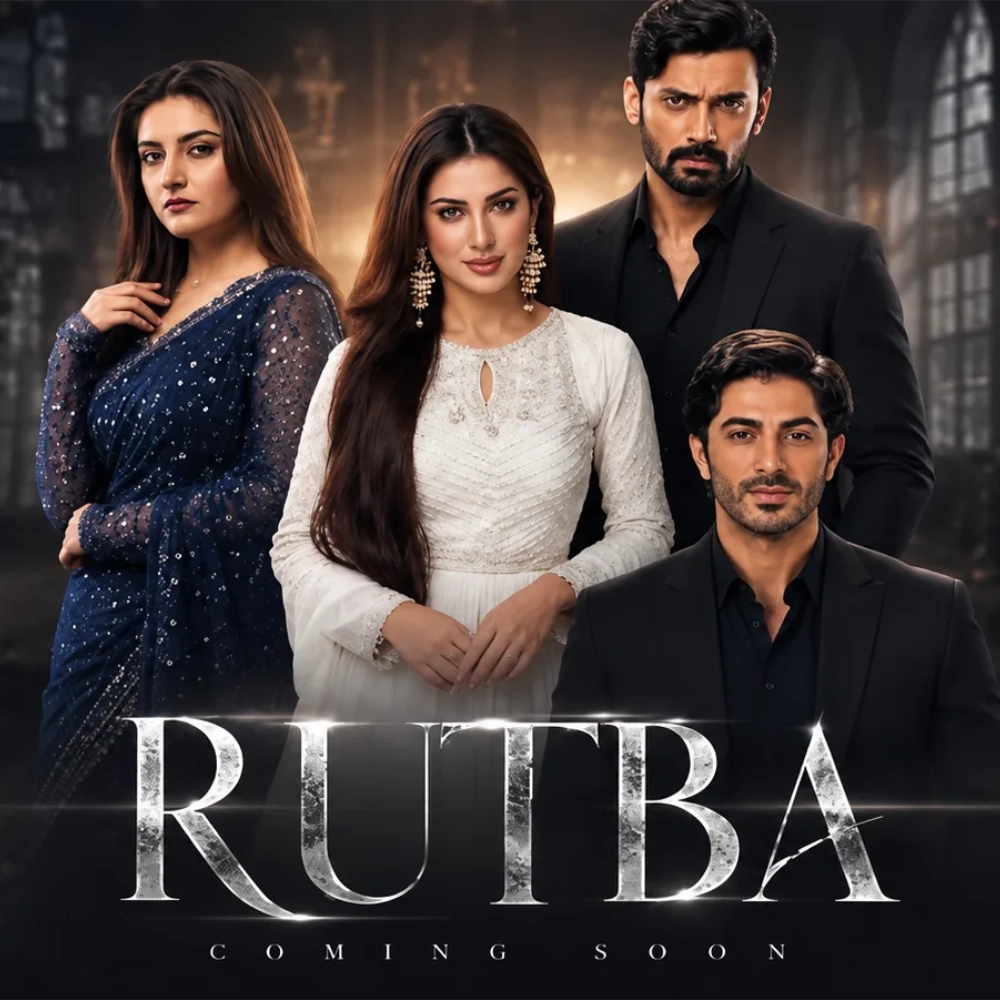
Rutba is a Pakistani drama that explores love, marriage, family values, social status, and the responsibilities that come with power. Written by Umera Ahmed and directed by Haseeb Hassan, the drama features Hiba Bukhari, Talha Chahour, Mehwish Hayat, Zahid Ahmed, Ali Tahir, and Salma Hassan in important roles.
The story initially focuses on Hadi and Mahnoor, a couple whose relationship has survived an eight-year wait. Although they come from different backgrounds, their love and commitment eventually bring them together in marriage. However, their journey is not simply about finding happiness. As they begin their married life, they must learn how to balance their personal values, family expectations, and the realities of a changing world.
As the story progresses, the introduction of Meer and Shelly brings a new layer of mystery and tension. Their presence expands the narrative beyond Hadi and Mahnoor’s relationship, suggesting that power, ambition, and hidden intentions will play increasingly important roles.
One of the most engaging aspects of Rutba is the relationship between Hadi and Mahnoor. Their eight-year journey establishes a foundation of patience, trust, and commitment before the main story begins.
Hadi, portrayed by Talha Chahour, comes from a simple village background. He values his faith, respects his parents, and believes that personal success should be accompanied by responsibility. His dream of entering public service reflects his desire to achieve something meaningful while remaining connected to the principles he has learned from his family.
Mahnoor, played by Hiba Bukhari, has grown up in a different environment. She is an independent-minded city girl with a lively personality and a strong attachment to her own lifestyle. Despite the differences between their families, she remains committed to Hadi and is willing to explore a new way of life with him.
Their marriage becomes a turning point in the narrative. Rather than creating an immediate conflict between the couple, the drama initially presents their relationship through warmth, understanding, and affection. Their early interactions demonstrate that two people can have different backgrounds without allowing those differences to destroy their connection.
However, marriage also introduces new responsibilities. Mahnoor must adjust to an unfamiliar environment, while Hadi must balance his professional ambitions with his duties as a husband. Their relationship will be tested as their circumstances become more complicated.
Rutba uses the contrasting backgrounds of Hadi and Mahnoor to explore an important question: can love successfully bridge the gap between two different lifestyles?
Hadi’s family represents simplicity, traditional values, and a close connection to faith. Mahnoor’s family, on the other hand, is accustomed to city life and a different set of everyday expectations. These differences become visible when the families meet and begin considering the practical realities of the marriage.
What makes these early developments interesting is that the drama does not rely entirely on exaggerated family hostility. Mahnoor’s parents express concerns about the lifestyle she may encounter, but their concerns come from wanting her to understand the changes that marriage could bring.
Mahnoor’s willingness to make her own decision gives her character an important degree of independence. She is not simply accepting a relationship without considering its consequences. Instead, she believes that her connection with Hadi is worth the effort required to build a life together.
The contrast between the families also creates opportunities for humour and emotional moments. Their interactions reveal differences in habits, expectations, and perspectives while establishing the environment in which the couple must learn to live together.
Beyond its romantic storyline, Rutba introduces a social dimension through Hadi’s professional journey. His progress toward a career in public service represents years of hard work and personal ambition.
Hadi’s father plays an important role in shaping his understanding of responsibility. His guidance emphasizes that authority should be used to help people and uphold justice rather than to establish personal superiority.
This message becomes particularly significant when Hadi begins encountering the realities of the professional world. Achieving a position of authority is only one part of his journey. The more difficult challenge is deciding how to use that authority when faced with pressure, influence, and people who may have interests that conflict with his principles.
The drama presents a contrast between the respect associated with an official position and the moral character required to deserve that respect. Hadi’s new status changes how some people perceive him, exposing jealousy, expectations, and assumptions about what professional success should bring.
Through this storyline, Rutba explores the difference between having power and exercising it responsibly. It also raises questions about whether a person can remain honest when the surrounding system encourages compromise.
The introduction of Meer, played by Zahid Ahmed, and Shelly, portrayed by Mehwish Hayat, gives the drama a more mysterious direction.
Their characters bring a different atmosphere to the narrative. While Hadi and Mahnoor’s relationship is initially built around sincerity and emotional security, Meer and Shelly introduce uncertainty about motives, personal interests, and the influence people can exercise over one another.
Their interactions create questions that the story has not yet fully answered. Their personalities suggest that there may be more beneath the surface than their initial appearances reveal.
The arrival of these characters also broadens the drama’s central themes. Social standing, influence, and ambition begin to intersect with the personal relationships established earlier in the story.
Zahid Ahmed brings a strong screen presence to Meer, while Mehwish Hayat adds intrigue to Shelly. Their performances help create anticipation about how their characters will connect with Hadi and Mahnoor and what those connections might mean for the developing narrative.
As the drama continues, their roles have the potential to challenge the apparent stability of the central couple’s life. The precise direction of these relationships remains part of the unfolding story.
The cast is one of Rutba’s notable strengths. Talha Chahour portrays Hadi as a man whose personal values and professional ambitions are closely connected. His character requires a balance between emotional sincerity and the determination needed to navigate an increasingly complicated environment.
Hiba Bukhari gives Mahnoor a lively and expressive personality. Her character’s independence, affection, and willingness to adapt provide an important contrast to Hadi’s more traditional upbringing. Their chemistry helps establish the emotional foundation of the drama.
Mehwish Hayat and Zahid Ahmed add another dimension through their portrayals of Shelly and Meer. Their introduction creates anticipation and adds a sense of uncertainty to the story.
Ali Tahir and Salma Hassan also contribute to the family dynamics, helping establish the values and expectations that shape Hadi’s background. These supporting relationships are important because they show where Hadi’s beliefs originate and why his decisions carry emotional significance.
Rather than depending solely on dramatic confrontations, the series uses family interactions and conversations to develop its themes. This approach gives viewers an opportunity to understand the characters before judging their decisions.
Umera Ahmed’s writing places relationships, morality, faith, and social responsibility at the centre of Rutba. The story begins with an accessible romantic premise but gradually introduces questions about ambition, influence, and the compromises people make in pursuit of their goals.
Haseeb Hassan’s direction brings together the personal and social dimensions of the narrative. The contrast between Hadi’s village background, Mahnoor’s upbringing, and the world associated with professional authority helps establish the different environments in which the characters operate.
The drama’s early episodes take time to establish the central relationship before introducing additional characters and conflicts. This gradual development allows the audience to understand what Hadi and Mahnoor have built together before the story begins placing that relationship under pressure.
The main challenge for the series will be maintaining a convincing balance between romance, social commentary, and mystery as the different storylines develop.
Rutba is a Pakistani drama that combines romance, family relationships, and social themes with an emerging storyline involving power and mystery. Hadi and Mahnoor’s eight-year love story gives the narrative an emotional starting point, while their contrasting backgrounds create opportunities to explore marriage, compromise, and personal independence.
Hadi’s professional journey introduces a broader discussion about integrity and responsibility. His desire to serve people provides a meaningful contrast to the influence and ambition that surround him. Meanwhile, the arrival of Meer and Shelly adds uncertainty and creates new possibilities for conflict.
The performances of Talha Chahour and Hiba Bukhari help establish the central relationship, while Mehwish Hayat and Zahid Ahmed bring additional intrigue to the developing story. The supporting cast also helps build the family environment that shapes the main characters.
Overall, Rutba offers more than a conventional love story. It examines how relationships respond to changing circumstances and how people behave when personal ambitions, social status, and moral responsibilities come into conflict.
As the drama is still airing, its long-term success will depend on how effectively it develops these themes and resolves the questions surrounding its characters. For viewers who enjoy Pakistani dramas featuring romance, meaningful family relationships, strong performances, and a developing mystery, Rutba is worth following.
Rutba Episode 1 Review: Love, Class Differences, and a Brother-in-Law Who Needs a Reality Check
Read Full Episode Review → Rutba Episode 2 Review: Love, Class Differences, and a Husband Who Needs a Lesson in Basic Manners:
Read Full Episode Review → Rutba Episode 3 Review: An Honest Officer, a Broken House, and a System That Runs on “Extra Income”
Read Full Episode Review → Rutba Episode 4 Review: No Bribes, No Gifts, No Favours… and Absolutely No Flowers!
Read Full Episode Review → Rutba Episode 5 Review: Hadi’s Principles, Shahnaz’s Flowers, and a Queen Who Knows Her Power
Read Full Episode Review → Rutba Episode 6 Review: Two Fallen Officers, One Frustrated ASP, and a Dangerous New Connection
Read Full Episode Review → Rutba Episode 7 Review: A Flowerpot, a Housing Scam, and an ASP Who Needs to Explain Himself!
Read Full Episode Review → Rutba Episode 8 Review: A Lost Necklace, a Growing Attraction, and a Rs. 500,000 Demand!
Read Full Episode Review → Rutba Episode 9 Review: Hadi’s Growing Interest, Meer’s Powerful Connections, and an Uncomfortable Party!
Read Full Episode Review →